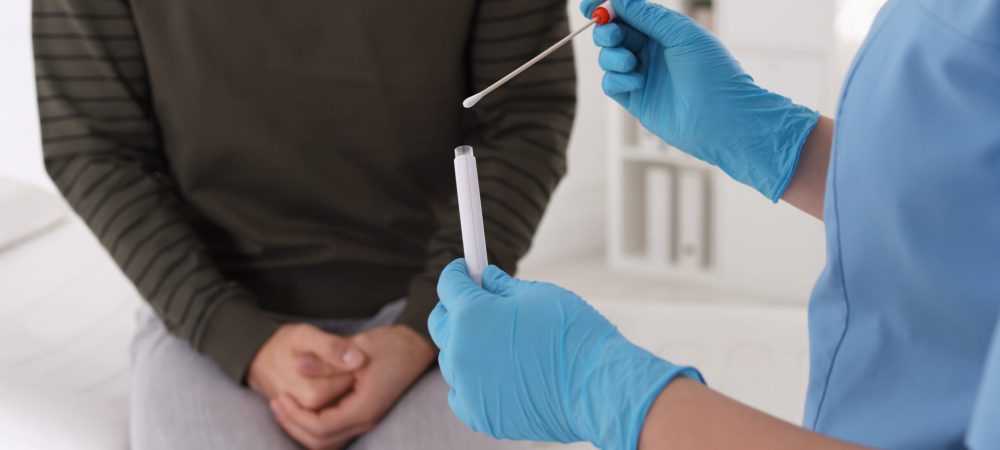
Doctor taking sample for STD testing from man in clinic, closeup

A New Option for Cervical Cancer Screening: Understanding Self-Collected HPV Testing

For decades, cervical cancer screening has relied on the traditional Pap smear performed during a pelvic exam. While this approach has saved countless lives, many women delay or avoid screening because of discomfort or scheduling challenges. 

A new option is changing that. 

The FDA has approved certain human papillomavirus (HPV) tests that let patients collect their own vaginal sample, making screening more comfortable and convenient. 

At Fairfax Family Practice Centers, we’re proud to offer the latest screening options and help our patients choose the approach that’s right for them. 

Why Cervical Cancer Screening Matters

Cervical cancer develops slowly, and in nearly every case, it begins with infection by certain high-risk types of HPV. 

HPV is extremely common. In fact, nearly 80% of sexually active adults will be exposed to HPV at some point in their lives. While most HPV infections go away on their own without causing health problems, a small percentage can lead to precancerous changes and eventually cervical cancer. 

The HPV vaccine is an important step in preventing cervical cancer, but it doesn’t replace the need for regular screening. Because HPV infections can occur years before cervical cancer develops, routine screening remains one of the safest and most effective ways to protect your health. 

What Is the New Self-Collected HPV Test?

Traditionally, cervical cancer screening has been performed with a Pap smear, during which a healthcare provider collects cells from the cervix during a pelvic exam. 

Instead of a clinician collecting the sample from the cervix, a self-collected HPV test allows eligible patients to collect their own vaginal sample using an FDA-approved swab or brush. 

The process is simple and takes a few minutes. Self-collection is available in two ways:

  1. In a healthcare setting. You can collect your sample in a private room at your doctor’s office or clinic using an FDA-approved swab or brush.
  2. At home. The FDA has also approved an at-home HPV self-collection test (the Teal Wand by Teal Health). With this option, you collect your sample at home and mail it to a lab for testing. Right now, this option is only available through certain telehealth providers. and insurance coverage may vary.

How Does It Compare to Traditional Screening?

Research shows that self-collected HPV testing is highly accurate at detecting high-risk HPV in people who are eligible for this screening option. However, there are a few important differences to know.  

  1. If your test is positive: If you use a self-collected HPV test and the result is positive, you’ll need to return for a follow-up visit so your healthcare provider can collect a cervical sample for additional testing. If your HPV test was collected by your healthcare provider, the sample from that visit can often be used for additional testing, which may help you avoid another appointment. 
  2. If your test is negative: The recommended screening interval is also different. After a negative self-collected HPV test, current guidelines recommend screening again in 3 years. After a negative clinician-collected HPV test, screening is generally recommended every 5 years. The shorter screening interval for self-collected testing is an added precaution while researchers continue to gather long-term data. 

Is Self-Collected HPV Testing Right for You?

Self-collected HPV testing may be an option for many average-risk women between the ages of 25 and 65. However, it is not appropriate for everyone. Patients with certain risk factors may need clinician-collected screening instead. Self-collected HPV testing is not recommended if you: 

  • Have HIV or another condition that weakens your immune system.  
  • Have a history of cervical cancer.  
  • Were exposed to diethylstilbestrol (DES) before birth.  
  • Have been treated for  significant precancerous changes of the cervix within the past 25 years. 

If you’re unsure which screening option is right for you, your healthcare provider can help you choose the approach that best fits your medical history and current health needs. 

The Bottom Line

Cervical cancer is one of the most preventable forms of cancer, yet too many women remain overdue for screening. The availability of self-collected HPV tests offers a promising new option for eligible patients to stay current with recommended cervical cancer screening. 

At Fairfax Family Practice Centers, we are committed to offering the latest evidence-based screening options for our patients, including the self-swab option. If you’re due for cervical cancer screening, don’twait. Schedule an appointment with your provider to discuss which screening option is right for you. 

This post was written by Broadlands Family Practice – Brambleton physician K. Michael Rodriguez, MD, FAAFP. 


New to FFPC? Find a location near you.

Call today to schedule an appointment.

703-726-0003

20905 Professional Plaza, #330

Ashburn, VA 20147


703-722-2312

22895 Brambleton Plaza, #200

Brambleton, VA 20148


703-263-9600

6201 Centreville Rd, #100

Centreville, VA 20121


703-481-1505

381 Elden St, #1000

Herndon, VA 20170


703-339-7550

8988 Lorton Station Blvd, #201

Lorton, VA 22079


703-257-8090

8100 Ashton Ave, #101

Manassas, VA 20109


703-766-5040

24430 Stone Springs Blvd #400

Dulles, VA 20166


703-834-1473

11800 Sunrise Valley Dr, #700

Reston, VA 20191


 703-255-9100

115 Park St SE, #300

Vienna, VA 22180

Recent Posts

Record Requests

Patients can securely request medical records via our release-of-information partner, Datavant. Please note that state and federal laws allow for additional fees for copies of medical records that are not requested by healthcare providers for direct patient care. To reduce costs, patients should consider requesting specific information rather than a complete record.